 Image 1 of 1
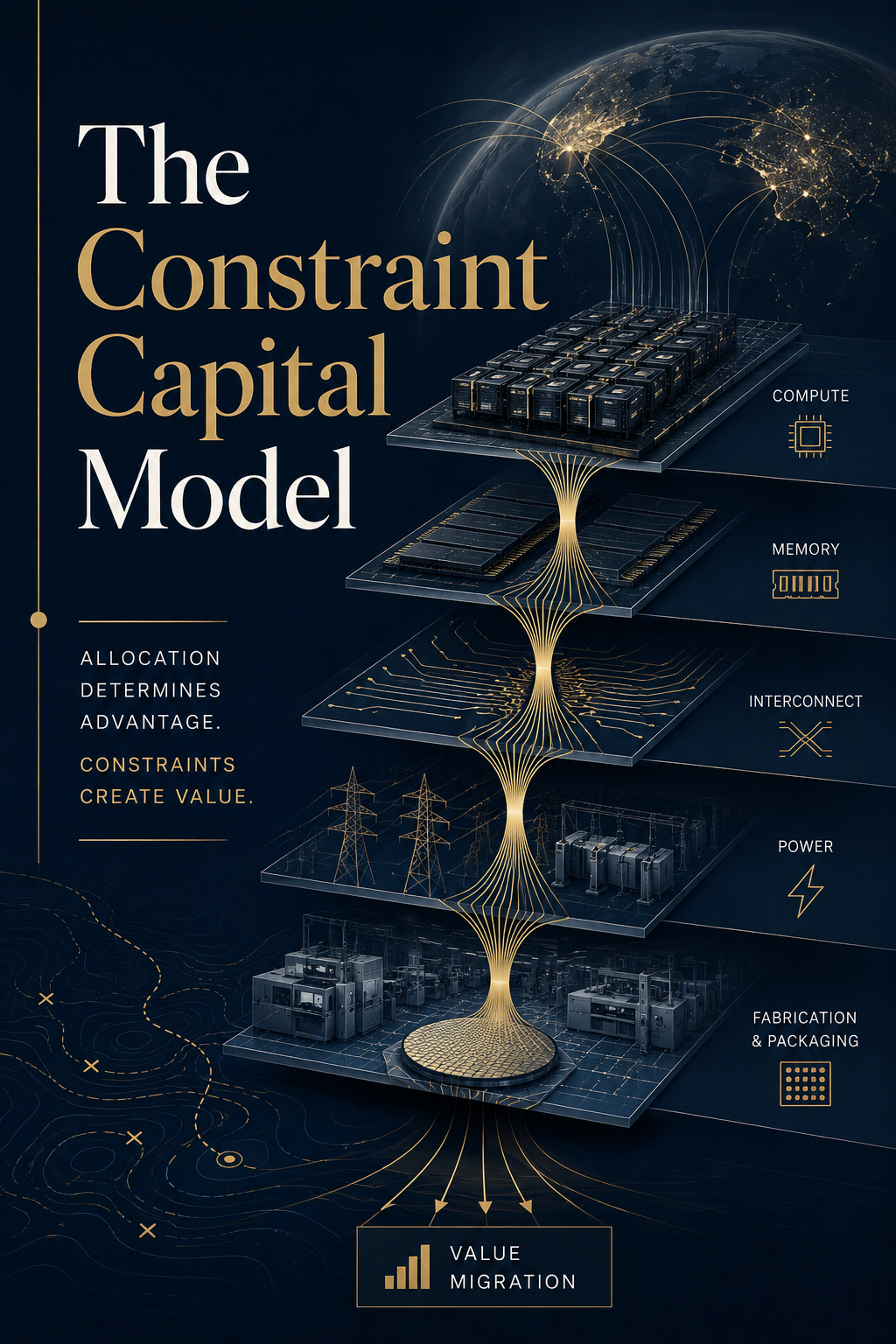
The Constraint Capital Model is a framework for understanding where value, risk, and opportunity migrate as artificial intelligence scales. Rather than focusing only on applications or individual technology winners, the model studies the physical and economic bottlenecks that determine whether AI can continue to grow: compute, memory, power, cooling, interconnect, fabrication, packaging, materials, and infrastructure.
The book argues that the next era of capital allocation will be shaped by constraints. As AI demand expands across cloud, enterprise software, robotics, autonomous systems, and national security, the companies that own, solve, or relieve the critical bottlenecks may become some of the most important businesses in the world.
The Constraint Capital Model is a framework for understanding where value, risk, and opportunity migrate as artificial intelligence scales. Rather than focusing only on applications or individual technology winners, the model studies the physical and economic bottlenecks that determine whether AI can continue to grow: compute, memory, power, cooling, interconnect, fabrication, packaging, materials, and infrastructure.
The book argues that the next era of capital allocation will be shaped by constraints. As AI demand expands across cloud, enterprise software, robotics, autonomous systems, and national security, the companies that own, solve, or relieve the critical bottlenecks may become some of the most important businesses in the world.